Point of View7 minute read
How to use AI as a personal assistant, without turning your life into a prompt
Most people try AI as an assistant, get a few good answers, and quietly stop. Usually it is not the model. It is that the assistant knows nothing about you.
The short answer
To use AI as a personal assistant, stop treating it as a search box and give it standing access to your own material. In practice that means five steps:
- Connect one real source first: your calendar, or the mail thread you keep avoiding.
- Delegate the small repeated work, not your hardest problem.
- Ask recall questions about your own history, not general knowledge questions.
- Say which of the three things you want: clarity, reassurance, or action.
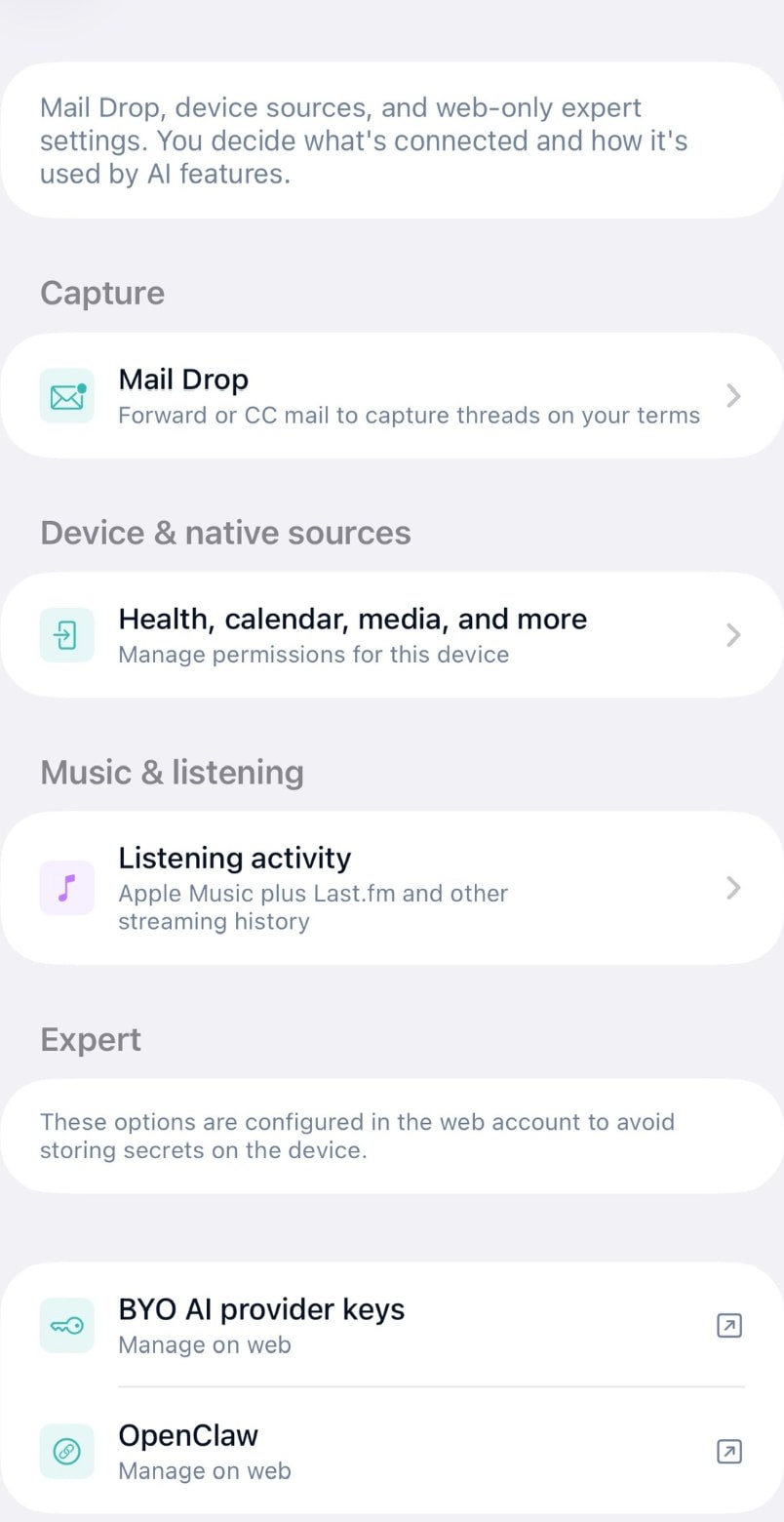
- Decide the boundary yourself: what it can see, what it keeps, and whether your material leaves your control.
Continued
The rest of this piece is why each of those matters, and what a realistic first week looks like.
The first time you ask a chatbot to plan your week it feels close to magic. The second time you notice you are doing most of the work. You paste the calendar. You explain who your kids are. You describe the project again. By the third go, typing the context takes longer than the task.
We hear a version of this from almost everyone who joins Souvéa. They are not short of intelligence on tap. They are tired of introducing themselves to it.
Start with the boring things
People test AI on their hardest problem, because that is where the pain is. It is the wrong test. Hard problems need judgement and stakes you own. The value shows up somewhere duller: the small repeated work that eats attention without ever making it onto a list.
A useful starting set looks unimpressive on purpose.
- Summarising the thread you have been avoiding, so you can decide in thirty seconds whether it needs you today.
- Turning a voice note into three next steps.
- Drafting the reply you keep postponing, so you edit instead of start.
- Answering questions about your own history: when did we last talk about this, what did I agree to, what did the doctor actually say.
- Telling you something about a pattern you are inside of and cannot see.
Continued
The last two are not tasks. They are recall and observation, and they are where the thing stops being a novelty. In our own use the moment that landed was small: after a heavy day, Souvéa connected the activity to the deep sleep that followed. Nobody asked it to. It had both, so it said something.
The bottleneck is context, not intelligence
A human assistant becomes useful in month three. Not because they got smarter, but because by then they know who matters, what you always forget, which meetings you protect, how you like things phrased.
Most AI assistants are structurally prevented from ever reaching month three. Every conversation starts at zero. Some products soften this with a memory feature that keeps a handful of facts you typed in. That helps a little. It is not the same as having access to what your life actually produces: messages, calendar, notes, documents, sleep, where you have been.
So the practical move is to stop tuning prompts and start deciding what the assistant is allowed to see.
Give it one thing to look at
The instinct is to connect everything and then feel uneasy about it. Do the opposite. Pick the one source carrying most of your mental load, usually the calendar or the thread you dread opening, and stop there for a few days.
One source is enough to answer the only question that matters: does it tell you something true you did not already know, and does it save you going to look? If not, five more sources will not rescue it. If it does, you widen the aperture on purpose rather than by default.
Say which of the three you want
Assistants get sold on action. Book this, send that, automate the rest. In practice a lot of everyday load is not waiting on an action at all. It is waiting on an answer.
Clarity is when you need to understand something: what is going on here, what did I miss. Reassurance is when nothing needs doing and you need to know that. Action is when something concrete has to change.
Most disappointment comes from asking for one and getting another. Ask for reassurance, receive a task list. Ask for clarity, receive a plan. Saying which mode you are in changes the answer immediately, which is a slightly embarrassing thing to discover about a tool this advanced.
Keep the boundary yours
An assistant that can see your life is genuinely useful and genuinely worth being careful about. Both are true at once, as long as the boundary is something you set rather than something you accept in a checkbox.
Three questions before you connect anything: what exactly can it see, can you look at and delete what it remembers, and does your material leave your control to improve someone else's product. If a company cannot answer those in plain words, that is the answer.
It is why we built Souvéa so the AI comes to your data instead of your data being shipped to the AI. Nothing is connected unless you connect it, and you can see what it kept.
A realistic first week
- Day one: connect one source. Configure nothing else.
- Day two: ask one recall question you would otherwise search for.
- Day three: ask what it noticed, without giving it a task.
- Day four: ask for a draft of something you have been putting off.
- Day five: decide whether it earned a second source.
Continued
That is a smaller ambition than most AI advice offers, and it is the version that survives a real week. The point is not that you use it constantly. It is that you carry less in between.